Thursday, January 10, 2013

Macedonian Mayhem, Rampant Romanians, and Belgian Blues - Ireland's France '98 campaign

The 1998 World Cup qualifiers marked the first post-Charlton adventure for an Irish team in dire need of new ideas and fresh blood, after a disappointing end to the Euro '96 campaign. Mick McCarthy was the man charged with rebuilding an Irish team in disarray, and despite many tribulations along the way, the campaign was eventually only one goal away from success. It will be remembered for a number of striking images - Roy Keane being booed at Lansdowne Road against Iceland, that horrendous orange jersey in Macedonia, and Shay Given's tears in Brussels. However, there was more to the story, and in a first of qualifying campaign retrospectives, this blog will recount the farce, false dawns and occasional spells of good football during the first - and most difficult - years of McCarthy's reign.

In January 1996, Mick McCarthy was appointed as manager of the Irish senior international team, edging out Kevin Moran on a contentious 3-2 vote. Despite names such as Johan Cruyff, Bobby Robson, Joe Kinnear and Kenny Dalglish being tenuously linked with the post at various times, the two final candidates were somewhat underwhelming; Moran had no managerial experience whatsoever, yet still pushed the more seasoned McCarthy all the way in the voting.

McCarthy inherited an ageing squad; the likes of Paul McGrath, John Sheridan and John Aldridge - key players in the Euro '96 qualifiers - would not feature significantly in the upcoming campaign. For veterans Andy Townsend and Ray Houghton, both approaching their mid-thirties, France '98 would represent a final opportunity to reach a major tournament. These familiar faces from the Charlton era would need to be replaced over time, and McCarthy used a tough series of friendlies to blood new players, mostly drawn from unfashionable Premiership reserve and second-tier sides. In his first eighteen months in charge, McCarthy gave first-team débuts to thirteen players, of whom only Shay Given, Ian Harte, Kenny Cunningham, Gary Breen and David Connolly became regulars in the long-run. Given the experimental nature of those early friendlies, an exasperating injury list, and the introduction of an irregular 3-5-2 formation, Ireland struggled - losing to Russia, Czech Republic, Portugal, Holland and the USA in early 1996. To add to the sense of chaos, Roy Keane inadvertently absented himself from the US Cup excursion that summer after a communication breakdown with McCarthy, resulting in a short exile from the squad and lingering doubts about his commitment. On the up-side, McCarthy was encouraging his players to pass the ball and build from the back, in marked contrast to his predecessor.

1996 was a time of huge transition for Ireland, but also a period of upheaval for the domestic game in England, where the best Irish players traditionally plied their trade. Expensive, high-profile foreign imports such as Vialli, Zola, Juninho and Ravanelli were making a huge impact in the Premiership, while the hype surrounding the successful Euro '96 tournament, and the growing cult of footballing celebrity - embodied by the 21-year-old David Beckham - was bringing unprecedented levels of media focus, glamour and resulting sponsorship into the English game. Over the coming years, enormous amounts of money would be pumped into the Premiership, following a European trail blazed by Manchester United in their relentless quest for Champions League success. The growing Continental influence could be seen in Arsenal's ground-breaking appointment of Arsene Wenger. From 1996 onwards, it would be increasingly difficult for Irish players to break into the top Premiership sides.

Ireland enjoyed a painless introduction to the World Cup qualifiers, having been drawn in a favourable group. The top seeds, Romania, had made little impression in Euro '96, and the also-rans - Iceland, Lithuania, Macedonia and Liechtenstein - had never even come close to qualifying for major tournaments before. Ireland swept Liechtenstein aside 5-0 in Vaduz, and impressively beat Macedonia 3-0 at HQ, showcasing McCarthy's new, more expressive style of play. However, the first hiccup came in the November game at home to Iceland; Roy Keane returned, and McCarthy chose to deploy the Corkman as a sweeper in the back three. Devoid of creativity in midfield and toothless up front, Ireland succumbed to a scoreless draw, handing the initiative in the group to Romania.

After a 0-0 friendly draw away to Wales, further cracks were beginning to appear in McCarthy's gameplan and selections. First, Paul McGrath was ejected from the squad for a breach of discipline, in circumstances which reflect poorly on McCarthy's approach to the defender's long-standing personal problems. Another bone of contention was the manager's favoured 3-5-2 formation. The uncomfortable deployment of McAteer and Phelan as wing-backs, along with Irwin and Staunton as proxy centre-backs, was compounding the failure of Phil Babb to step up as a senior member of the defence. A disaster was waiting to happen, and it duly arrived on a grim Skopje afternoon, which goes into the annals as one of Irish football's darkest days. Despite taking the lead against Macedonia through Alan McLoughlin, the wing-backs conceded a penalty each, both converted by Stojkovski. Ireland's ramshackle defence allowed the counter-attacking Georgi Hristov to run through for a third in the second half. A David Kelly consolation came too late for a comeback, and Ireland's frustration was demonstrated by McAteer's needless sending-off, which ruled him out of the following Wednesday's daunting trip to Bucharest.
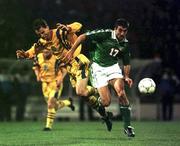
Romania, boasting the talents of the veteran Hagi, had breezed through their opening fixtures with a 100 per cent record, and were five points clear going into Ireland's visit. McCarthy had some serious reshuffling to do, and was forced to revert to a flat back four, restoring Irwin and Staunton to their rightful full-back positions, bringing in Cunningham alongside Harte at centre-back, and playing Connolly as a lone striker. A much-improved performance should have yielded more than a 1-0 defeat, but when Houghton was taken down in the box, Roy Keane's penalty was saved. Eight points behind the Romanians, Ireland would be playing for second place in the group, a fact unchanged by a 5-0 win over Liechtenstein in May. David Connolly scored a hat-trick in that game, and his eye-catching international form was rewarded with a move to Feyenoord in the close-season.
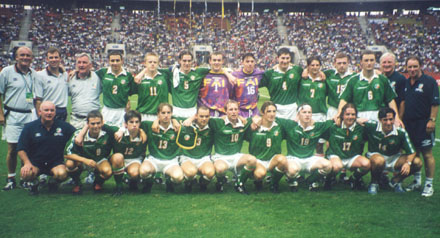
The jury was still out on McCarthy by the summer of 1997, despite the FAI granting a public vote of confidence. Mishandling of personal issues with Keane and McGrath, added to some bizarre decisions in terms of formation and team selection, and the manager seemed to be on thin ice. However, Ireland had been beset with injuries since the beginning of the qualifiers, notably long-term absences for Gary Kelly and Niall Quinn, which disrupted any attempts to field a settled side. The abject form of Babb and McAteer - Liverpool regulars and two of Ireland's most high-profile players - was also a big disappointment. However, there were some chinks of light - Brian Kerr's U-20s came third in the FIFA World Youth Cup in Malaysia in the summer of 1997, eliminating Spain en route before narrowly losing to an Argentinian side containing Samuel, Cambiasso, Aimar and Riquelme. Blackburn's Damien Duff was earmarked as a future star, while Tottenham's Neale Fenn was rewarded with a senior call-up for the home qualifier against Lithuania in August.

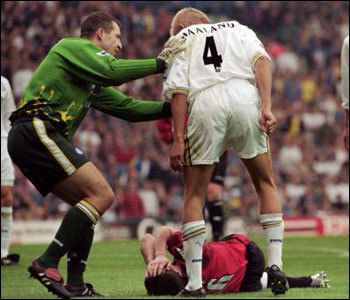
Keane suffers his season-ending injury at Elland Road
Ireland's insipid 0-0 draw with the Baltic nation meant that the upcoming games in Reykjavik and Vilnius were must-win affairs. In the first game, Ireland had to rely on a Roy Keane double, after a shock second-half deficit, to win 4-2. Another hard-fought victory followed against Lithuania, with the 35-year-old Cascarino netting both goals to secure second place in the group. The final group match - a 1-1 draw at home to Romania - was rendered meaningless, notable only for a fantastic Hagi free-kick and Cascarino's 19th international goal. By then, however, Roy Keane had succumbed to a cruciate ligament injury playing for Manchester United, and would miss both the upcoming playoffs and the World Cup itself, in the event of qualification. It was a sickening blow for McCarthy's side, as Keane was beginning to find his best form at international level after an inauspicious start under McCarthy.

The playoff draw was relatively kind to Ireland, avoiding the heavily favoured Italy, Russia, Croatia and Yugoslavia. Ireland's tie with Belgium was regarded as the 'cripple fight' of the playoffs, as Belgium were in transition under George Leekens, having failed to qualify for Euro '96. McCarthy made a strange call in his tactics for the first leg at Lansdowne Road, deploying Kennedy in a free role behind Cascarino and Connolly, with Staunton in midfield, in a 4-3-1-2 set-up. The plan worked for the opening ten minutes, as Ireland took the lead through a fantastic Irwin free-kick, but the home team was soon overrun in midfield, and Nilis fired a precious away goal on the half-hour. Belgium went on to dominate the game, and a 1-1 draw was flattering to McCarthy's faltering side. The manager came in for criticism, particularly for fielding Ian Harte as a makeshift centre-back, and for the lop-sided midfield, where Kennedy - a favourite of McCarthy's from his Millwall days - had been wholly ineffective.

Ireland were given little hope of overturning Belgium's advantage, and McCarthy reverted to a 4-5-1, with McLoughlin and newcomer Lee Carsley brought in to stiffen up the midfield. Accordingly, Ireland turned in a much-improved performance in the Brussels rain, but were caught with a counter-attack on 25 minutes, when Oliveira capitalised on Given's misreading of a through ball. Ireland persevered, and grabbed a deserved equaliser through Houghton with half an hour left to play. Momentum was in Ireland's favour, but ten minutes later, Nilis - effectively man-marked by Carsley all night - took advantage of some sloppy play - and the non-awarding of a rightful Irish throw-in - to evade his marker and slot home. A further away goal would have seen Ireland through regardless of Nilis's strike, however, and McCarthy threw caution to the wind, bringing on Connolly for Kennedy. However, the young striker aimed a petulant kick at Verheyen, and was duly sent off. Belgium comfortably played out the final minutes against Ireland's ten men, and tears were shed at the final whistle.


When interviewed after the final whistle, McCarthy voiced his grievance with regard to the lead-up to Nilis's goal: "It was definitely our throw, but that decision, when we were on top, cost us a place in the World Cup. Now I've said my piece about it, and don't want to discuss it any more, but I am unhappy with it, even though we could have defended better against the throw-in. The result obviously feels like the worst moment of my career right now. But with the sense of sorrow there is also a feeling of pride and hope about our performance.' Leekens was probably more on the mark when he played down the incident, and suggested that Ireland had really lost the tie in Dublin, when McCarthy's bizarre reshuffle in midfield caused the team to lose their grip on a winnable tie.

In retrospect, a more seasoned manager than McCarthy could have successfully navigated what was, on paper, a relatively easy group. McCarthy's tactical naivety, and a seeming indecision about his preferred starting line-up, contributed to a lack of momentum, organisation and confidence within the Irish side. Had Ireland not dropped such careless points against Iceland, Lithuania and Macedonia, they could have qualified for France '98 as best runners-up. However, injuries also played a huge part in the campaign, and Ireland relied heavily at times on the likes of Townsend and Houghton, who were not the forces of old at international level. The lack of a prolific striker, and the absence of real pace and creativity in the wide positions, were glaring weaknesses. Expensive Liverpool players McAteer and Kennedy had been found wanting in the latter regard, and though young strikers Connolly and Keith O'Neill had started brightly in the initial friendlies, Connolly's form tailed off after his ill-fated Dutch move, and O'Neill's injuries would, in time, force his premature retirement. Ireland's striking dilemma was exemplified by the continuing presence of Cascarino, Coyne and David Kelly - strikers with a combined age of 102. However, there were a couple of prospects coming along - 18-year-old Damien Duff had followed his youth-level heroics by breaking into Blackburn's first team, and there were encouraging reports about an exciting 17-year-old striker at Wolves. Though McCarthy had made mistakes, the FAI's decision to hire an up-and-coming ex-player instead of a more experienced manager was borne of an understanding that the incumbent would learn 'on the job'. McCarthy was generally respected within the dressing-room, it seemed, and the away leg of the playoff had shown signs of progress. If he could learn from his mistakes, keep the young players coming through, and maintain Ireland's improvement into the next campaign, all the better. Brighter days were surely to come for McCarthy and his evolving side.


Ireland 3-0 Macedonia, 1996

Macedonia 3-2 Ireland, 1997

Romania 1-0 Ireland, 1997

Ireland 1-1 Belgium (Playoff first leg)

Belgium 2-1 Ireland (Playoff second leg)

Tuesday, January 8, 2013

End of year assessment


It's been a bit of an ‘annus horribilis’ for Ireland. Few positives to take away, though the standard of opponent was, in Germany, Spain, Croatia and Italy, of a greater calibre than any that Ireland have faced in one year, as far back as this blogger can remember. In the past, Ireland have been able to take points off bigger sides when - like Holland in 2001 and France/Italy in 2009 - the opposition has proven over-rated, badly coached and vulnerable as a result. It didn't happen with the more illustrious opponents this year.

This blogger is not a utopianist when it comes to the Irish side - Ireland have never consistently won games or strolled to qualification by playing free-flowing football; even in that outstanding campaign for 2002 under McCarthy, the team had to rely on graft, grunt, good defence and good fortune at various times, epitomised by the stubborn resistance of Roy Keane against Portugal, and the last-gasp heroics of Shay Given in the playoff against Iran. So, with that in mind, this blogger was a Trap supporter between 2008 and 2011, opining that the style of play, based on solid defence and a hard-working, stifling midfield, was appropriate for the player pool in terms of grinding out results against weaker sides and picking up points against the higher seeds. The 2012 qualifying campaign was a success - too many times, Ireland have thrown away qualification for want of results against lower-seeded teams - think Liechtenstein and NI in 1995, Macedonia in '97 and 99, Lithuania and Iceland in the '98 qualifiers, Israel home and away in 2005; Trap eliminated those silly results, which have enabled the team to be competitive at the 'business end' of the table. Even now, we stand on six points from a possible nine. Trap deserves some credit for that, given that our player pool has been quite weak over the last few years.

However, the damning fact about Trap's tenure - all the way along - has been his bizarre selections on the fringes of the squad, and his refusal to make unforced changes to the starting XI. The team that started against Croatia was identical bar Kilbane/Ward from the first-choice in 2009. Players have not been able to play their way into the side on club form, which is simply wrong. This policy has come home to roost this year with the various injures and retirements, particularly against Germany, when Ireland started with five Championship players - while regular EPL players like Long, Hoolahan, O'Brien, Gibson, McClean, Clark and Wilson languished either on the bench or at home. These players should have been blooded 12-18 months ago. Now we're faced with the prospect of a Sweden/Austria double header in March, where the fans are disillusioned, resigned to the fact that the best team will not be picked. Even if by some miracle, Trap picks the right team, Ireland's most talented players will be going into the game without much international experience, having been waiting in line behind journeymen for the last two years. It doesn't fill anyone with hope.

Add to this the fact that the defence - so reliable in 2011 - seems to have fallen apart. Even Oman and the Faroe Islands recently breached Ireland's brittle rearguard, which currently looks like conceding in every game. Also, Trap has developed an irritating new habit of playing strikers on the wing, which is almost Staunton-esque in its absurdity. Ireland may be playing for nothing more than future seedings after March, unfortunately. Trapattoni is not getting the best out of the current pool of players, and the trends of the last year are worrying, since Sweden and Austria present a much tougher proposition than Bulgaria/Cyprus or Slovakia/Armenia.

Still, on the plus side, there seems to be a decent conveyor belt of talent - no world-class individuals, but plenty of players who could have a good international future. Coleman, Wilson, Brady, Clark and McCarthy have been introduced to the team, and others should follow. Gibson will be a big asset if/when he re-commits. Here's hoping that McClean can step up again, and that Pilkington gets his passport sorted. Meyler and Stevens could emerge as credible options too. We'll surely have a bolter like Garvan, Quinn or Mason getting promoted and getting more exposure to the top level, which may give Trapattoni another option or two. The U-21s achieved a fine victory over Italy in the autumn, and hopefully the better players from that level - Egan, Duffy, Cunningham, Hendrick - continue to develop. We'll surely see one of the other Villa kids step up too, and hopefully the LOI will continue to produce talent of the Stevens/Maguire/Forrester mould. In terms of the player pool, things should improve.

However, the positive influence that Trap brought to the side in 2008 - organisation, discipline, solid defence, ability to grind out results - seems to have been lost over the last year, and the beatings handed to the Irish team in 2012 will not be forgotten. The side needs an injection of new blood and confident, in-form players, and we have the resources to do so - but I'm far from convinced that Trap is the man to preside over such a transition.

Thoughts pre-Germany game (October 2012)


This is a strange feeling. I'm actually dreading this game. I wrote on here before the Serbia squad announcement that if we didn't see widespread changes in selection, tactics and formation, it would be a long two years. Now we're going into the Germany game, and it looks like O'Shea and Ward at full-back again, Whelan and Andrews in the middle again, and the added idiosyncrasy of Cox or Keogh in midfield. With two centre-backs who have never played at a higher level of club football than second-tier in England, and a veteran striker who has looked off the pace and remained goalless in his last eight internationals.

I've always been a strong supporter of Trap. The discipline, organisation, purpose and common-sense he brought to the side in 2008 was refreshing, the tactics were spot-on for the players we had available, and the performance in Paris was one of the most compelling we've ever shown, under any manager. Despite qualification, the last campaign was, if anything, less convincing performance-wise, and wrong options were taken with regard to blooding new players, but we got the results we needed. Even now, the only games we've lost under Trap have been against teams who are seeded and ranked higher than us. Disappointing home draws with Slovakia and Bulgaria were cancelled out by good performances and fine points in the away games. You can't fire a manager for merely failing to over-achieve once projected targets are met, which is what Trap has done.

However, the Irish player pool has changed and evolved since 2008, while the selections, the approach, and the tactics have not. In the last couple of years, we've had a number of excellent young players coming through to play regular EPL football. The focus should be on accommodating and getting the best from these players. It hasn't been done. The likely starting line-up in a week's time will contain six players (Ward, O'Dea, St. Ledger, Andrews, Cox/Keogh, Keane) playing at an inferior level of football to the contenders for their spots (Wilson, Coleman, Clark, McCarthy, McClean, Long). Arguments can be made that the incumbents have done little wrong while playing for Ireland, but their misfortunes at club level are worrying - if they genuinely still had the quality to play in a successful international side, they wouldn't be plodding away in second-rate leagues, for second-rate clubs. True, the likes of Alan Kelly, Alan McLoughlin and David Kelly had decent international careers while playing in the second-tier, but players like that are generally the exception. You need a core of players who are in form, playing for good clubs, and attuned to playing against the best. We have a number of those players, but they're not being used. If we steadfastly accepted the logic that 'if they've done okay for Ireland, it doesn't matter what level they play at for their clubs', we'd still have Liam Miller, Martin Rowlands and Eddie Nolan stinking up the squad.

Trap's insistence on sticking with the more 'workmanlike' players could be justified if our defensive record was as impressive as before, but we've conceded 14 goals in our last 12 games, leaking goals even to Armenia, Estonia and Kazakhstan in competitive games. The signs aren't good. Trap's tactics are built to compensate for our lack of technique, and to play to the traditional Irish strengths of attrition, stubbornness and hard-nosed physicality, which are admirable traits in sport, but useless in a modern era, where soccer has been changed (and arguably emasculated) by Blatter and Platini's insistence on undermining the physical, combative element of the game.

The squad actually looks weaker and less-developed now than at any time in the last four years, and the manager has to carry the can for that. Unfortunately, I think the direction from Trap, which was refreshing, purposeful and pragmatic at the beginning, has become wayward and lost. He is a legendary manager, and I'm not convinced that we'll get an ideal replacement at the end of this campaign (because let's face it, he's going nowhere until his contract runs out), but his ideas are not sitting well with Ireland right now.

I can only hope that our seeding does not suffer too badly in this campaign, and that the next manager doesn't have to build from a 'McCarthy 96' type of wreckage. Or that Trap surprises us all by making the calls that need to be made (O'Shea at CB, Ward and Whelan dropped, Coleman, McClean, McCarthy and Long in). On all counts, I'm not too optimistic.

Concerns about Ireland's immediate future (August 2012)

The biggest indictment of Trapattoni from Euro 2012 was that the starting line-up against Italy contained nine players who started against Italy in Croker in 2009. Given that Duff was injured for that Croker game, and it looks like the only change Trap has made in three years has been to replace Kilbane with Ward - a forced change, in many respects. Italy, by contrast, had only four survivors from 2009 in their starting line-up (Buffon, Chiellini, Pirlo, De Rossi). Statistically, we had the oldest squad in the tournament. We now have a stagnant team in dire need of change, which has been an underlying fear despite our commendable results in the qualifying campaign.

Since 2009, we have had 14 friendlies to try out new players, and given out 14 new caps (Fahey, Green, McCarthy, Cunningham, Sheridan, Clark, Wilson, Walters, Cox, Ward, Coleman, Treacy, Forde, McClean), which doesn't exactly point to an unwillingness to try new talent. Unfortunately, some of our better up-and-coming players had to pull out of squads at times when they had a real chance to cement their places. Also, Gibson and Foley were given opportunities to push on into the starting XI, but they both 'fluffed their auditions' to an extent at home to Macedonia, and they weren't given much of a chance thereafter. It's not like Trap hasn't tried to reshuffle, but it just hasn't worked out for a number of individual players. On the other hand, Trapattoni has also been guilty of misjudgement of players in a number of positions; McCarthy as a 'free role' player, Clark and Wilson being ignored as utility options, Foley in CM, O'Shea at RB, unwillingness to drop Whelan or Andrews even when hideously out of form, picking Keogh as the midfield/forward utility option instead of trying Hoolahan, and keeping faith with Green and McShane in the squad. In this campaign, there will be no margin for error in our team selections. If we have players out of form or out of position while better alternatives are left on the bench or out of the squad completely, we will be punished.

As for the system, well, as has been pointed out on this and other threads, we have the same problem with Robbie Keane as England have had with Wayne Rooney; how do you leave out the top goalscorer? With 12 goals in 18 games in 2010/11, he had to be fitted in somewhere, and as he proved at Liverpool, he isn't well-suited to a lone striker or AM role in a 4-5-1 or 4-3-3 variant. Keane's presence has certainly dictated the shape of the team; Trap mused about using Keane in the 'Totti' role, but Keane's natural game is to play on the shoulder of the last defender - Keane has often looked confused when attempting to drop deep (Bulgaria away is a good example of this). Our last win against a mid-to-high seeded team was against Slovakia in 2007, when Keane was suspended and Staunton accidentally stumbled upon his best team; 4-5-1 with Duff, Ireland and McGeady playing behind Kevin Doyle. The extra man in midfield compensated for the fact that we had limited players in CM (Carsley and Kilbane) who both struggled in a 4-4-2 in that campaign. The change in formation is definitely workable for Irish players, and can pay dividends. Now that Keane is winding down his career, it's an ideal time to look at alternatives.

Where to from now? We can write Euro 2012 off as a bad experience. Sweden and Denmark had awful Euro 2000 campaigns, but qualified for most of the tournaments in the following twelve years. I'd be more than happy if we could do the same. The formation needs to change, and the squad needs some fresh blood; that's absolutely clear now. The current starting XI has stayed together for too long, and grown stale. We have a much wider pool of talent than what was available in 2008/9, and the likes of Wilson, McCarthy, Gibson, Hoolahan, McClean and Long should be central to the team's development, after having good seasons last year - not just fringe players. If Clark, Coleman, Meyler, McCann, Brady, Duffy, Cunningham and others make better headway at club level, it should be recognised and rewarded.

The next squad/team announcement is going to be very interesting, and could well define our campaign. If Trap keeps faith with 4-4-2 and fails to shake things up at full-back and central midfield, and continues to ignore club form, it'll be a long two years. I'm just hoping for change, and for the right changes to be made, and that our young players can step up to our expectations. Are the FAI right to keep Trap on? I would say a cautious and partly resigned 'yes'. As Sanchez and McLeish/Smith showed with NI and Scotland, a good club job is far more attractive these days than a mid-ranking international job. If the FAI are, as expected, to return to modest wage packets, our next manager will probably be someone with very little top-level experience, or someone with significant blotches of failure or mediocrity on their CV. Giving Trap the sack after qualifying for our first tournament in 10 years would make the Irish job seem like an extremely unattractive and thankless proposition, even for an accomplished and ambitious manager. Either way, it'll be a risk, and I suppose it's a case of 'better the devil you know' for the time being.

How can Ireland go forward? (August 2012)

When a team moves up to a higher level of competition, sometimes disappointment is inevitable. A good, technical Serbian team went into the 2006 World Cup with a core of excellent players such as Vidic, Kezman and Stankovic, boasting an unbeaten record in qualifying from a group containing Spain, Bosnia and Belgium. In the World Cup itself, Serbia lost 6-0 to Argentina and exited from their group without a point, a dismal record only equalled by Costa Rica. Tournament football at the highest level is punishing and immensely cruel at times. Ireland found that out in the summer of 2012.

There has been a great deal of criticism directed at the management from Irish fans and media in the wake of the disappointing tournament. This soul-searching is not borne out of an expectation to conquer at the highest level – only a fool would think a country of Ireland’s standing should be demanding consistent victories against Europe’s elite. However, Ireland now face into a difficult qualifying campaign, a group with a different dynamic to the previous campaigns under Trapattoni. Germany, Sweden and Austria provide the competition, with the Kazakhs and Faroes making up the numbers – and second place cannot even guarantee a playoff. The performances that got Ireland through the last two campaigns will simply not be good enough this time. With a generation of players seemingly in need of replacement, and promising youngsters in need of experience, Ireland face into a time of transition and uncertainty. Trapattoni faces his toughest challenge to date, and many fans are not convinced he’s up to the job, despite good results in previous campaigns.

The main concerns are rooted not just in previous results against better sides, but performances and team/squad selections – it’s difficult to quantify the strength of Ireland’s playing resources if they are not being utilised to the full, and many fans are not convinced this is the case. The repeated selections of Championship players like Paul McShane, Paul Green, Darren O’Dea and Andy Keogh in the squad have caused considerable disillusionment with the manager’s judgement, as there are in-form alternatives playing at a higher level, making compelling cases for inclusion. Every good performance from the likes of Wes Hoolahan, Anthony Pilkington and Ciaran Clark in the EPL will serve to put further pressure on the Irish manager and those he picks in their stead – pressure which could be easily avoided. Keogh, O’Dea, McShane and particularly Green have often looked uncomfortable and ineffective at international level, and could easily be discarded without weakening the squad. Their retention seems more borne of stubbornness than pragmatism, as they have done little on the pitch to warrant a place in the squad.

Also, the rigidity of Ireland’s 4-4-2 formation has been exposed time and again, with even lowly opponents dominating possession in games, and Ireland seemingly handing the initiative to beatable teams at home, as was evident against Bulgaria and Slovakia. This policy was punished ruthlessly in Poland, and will be against Germany and Sweden unless something changes. The problem for Ireland lies in the technical ability of the full-backs and central midfielders; for a 4-4-2 system to work, the central midfielders should have enough technical ability to receive the ball and pick out forward passes even when outnumbered. Neither Whelan nor Andrews have this kind of ability, and are picked on the basis of defensive strength and attrition – a factor rendered increasingly meaningless given FIFA and UEFA’s continued efforts to remove physical contact from the game. The full-backs – vital for building possession in the modern game – also seem unable to pick out accurate passes, leading to hopeful balls into the channels, where Ireland’s physical strikers usually tend to fall foul of international referees who lack the leniency of their EPL counterparts.

Another complaint with the flat 4-4-2 is the isolation of the strikers in general play. Robbie Keane’s spell on loan at Aston Villa showed that the top scorer does have the ability to drop deep and help out in midfield if needed, but he has not done this for Ireland, apparently being under instruction to play close to his strike partner, on the shoulder of the opposing centre-backs. A small adjustment to the striker’s role could have borne fruit at times when more numbers were needed in midfield, but it hasn’t happened, and it seems clear that opposing teams have cottoned on to the deficiencies of Ireland’s undermanned engine-room.

Trapattoni has been accused of deliberately employing the more attritional, direct tactics to compensate for the lack of technical ability at his disposal, essentially surrendering possession. However, Ireland have not always played like this under the Italian. With Steve Finnan and Steven Reid in the side, Ireland played a much more measured game at the start of the 2010 World Cup qualifiers. The injury and subsequent international retirement of both players was a blow to Ireland, immediately felt in the following performances, and neither player has been effectively replaced.

These problems could be eliminated with just a little bit of tweaking. Between Coleman, Wilson, McCarthy, Gibson, McClean, McGeady and Long, there is enough young talent available to build an effective, competitive side, and to slowly phase out the players who can’t compete effectively at this level. The big fear for Ireland is that the manager’s often eccentric faith in the old guard of Whelan, Andrews, Ward, McShane, et al, will not allow that to happen, and that the stagnation in the current side could become something terminal, leaving any future manager with an unfavourable seeding position and a huge rebuilding job. Trapattoni is contracted for another two years, and is going nowhere, so the critics will just have to put up with it – but we can only hope that he has learned a few lessons from the painful Euro 2012 experience, and that he shows a willingness to change the current personnel and tactics. However, the young players also need to step up and prove that they are worthy of the hype. Many of these players – particularly Gibson, Wilson and McCarthy – have only themselves to blame for not yet cementing their places in the Irish starting XI. They need to make a case for inclusion that Trapattoni cannot resist.

Disappointment, not Disgrace (July 2012)


Disappointment, but not disgrace, for a team who merely punched their weight

Before Euro 2012, most objective observers would have agreed that anything exceeding one point would have represented over-achievement for the Irish team; a team ranked sixteenth out of sixteen competing nations, a team sorely lacking in top-quality performers. In the 2011/2 season, no Irish players featured in the group stages of the UEFA Champions League. Ireland’s squad contained five players from the second tier in England, as well as a further four on the books of relegated teams from the EPL. The only medal won by an Irish player in the 2011/2 season was by Robbie Keane – for his contribution to LA Galaxy’s MLS win.

It was generally perceived that Ireland’s foremost players were some way past their best, with the remainder of the squad having something of a journeyman look. Duff, O’Shea and Keane had played for top clubs in their prime, but were in the process of winding their careers down with less-fashionable sides. The likes of Given, Dunne, McGeady and Doyle were quite highly-rated at times in their club careers, but not highly enough to convince an established Champions League side to acquire their services, despite all being linked with big moves at various times. Gibson, McClean and Long were emerging as decent EPL players, but hardly outstanding prospects on a European level.

The remainder of the squad was comprised of journeymen – embodied by the likes of Keith Andrews, who had spent almost his entire career in the English lower leagues before securing an unlikely move from MK Dons to then-EPL side Blackburn at the age of 28. As a youth at second-tier Wolves, Andrews had looked on from the wilderness as the successful Irish U-18 and U-20 sides of 1997/8 competed for trophies, and the Dubliner was restricted to a handful of U-21 caps by competition from highly-rated young prospects such as Barry and Alan Quinn, Stephen McPhail, Liam Miller, and Colin Healy, who would all fall by the wayside at the top level. Andrew’s abrupt, highly fortunate rise saw him overtake Ireland’s underachieving ‘Golden Generation’ of young midfielders to take his place as a regular in Trapattoni’s midfield – a fact that reflects more on unfulfilled potential elsewhere rather than the hard-working, gritty merits of Andrews and his oft-maligned midfield cohort Glenn Whelan. There were very few ‘boy wonders’ available to Ireland in 2012 – mostly players who had to forge their careers the hard way in the English game, like Andrews and Whelan.

On paper, Ireland did not have the requisite talent to trouble seasoned top-level European nations, but expectations were heightened by a history of over-achievement and good fortune at big tournaments – particularly in 2002, when an Irish team drawn mainly from the mid-to-low reaches of the EPL had taken Spain to penalties after battling through the group stage and a tough qualifying campaign, eliminating Holland en route. Historic wins against England and Italy during the ‘Charlton Years’ also contributed to the Irish footballing zeitgeist, and Trapattoni’s squad were expected – perhaps unfairly – to deliver another scalp against Spanish, Croatian and Italian opposition – the latter two teams being regarded in some quarters as fragile and possibly over-rated.

Unfortunately for Ireland, the opposition played to their considerable potential, and although we could point to basic individual mistakes from otherwise-dependable players, flawed tactics and so forth, we have to be honest with ourselves. We have a collection of good professionals, who operate at a high enough level to grind out results against the awkward, ‘banana-skin’ sides which compete in the majority of our qualification games. We have the ability to get results against the sides immediately around us in the UEFA seedings, and should expect to be in contention to qualify from most groups drawn from the UEFA zone. However, at the highest level, we need our best players to be at the top of our game, along with a healthy slice of luck, to get results.

The manager will always carry the can for underachievement and poor results. However, on the results alone, any objective analysis in the bigger picture would show Trapattoni’s tenure in a positive light. Ireland were seeded third for the last two qualification groups, yet finished second each time. They have lost only two qualification games out of twenty-four, and recently underwent a thirteen-game unbeaten run. Ireland have lost five competitive games under Trapattoni – against France, Russia, Croatia, Spain and Italy. Ireland did not go into any of those games as favourites – certainly not among neutral observers.

In the last twenty years, Ireland have thrown away qualification for four different tournaments under three different managers, simply because of dropped points against Liechtenstein, Northern Ireland, Lithuania, Iceland, Macedonia and Israel. Trapattoni has avoided such eventualities, and made sure that we have punched our weight. Surely the improvement in results would be seen as a commendable achievement? There is only so far a team of limited ability can go, after all, and Ireland’s pool of players is currently average at best. Ireland’s record at Euro 2012 was disappointing for those of us who had hoped beyond hope that we could pull off a shock. It was not an embarrassment, nor a disgrace, and that is why the Irish fans did not boo the team off, unlike that dark Croke Park night in November 2007, when Cyprus came within two minutes of claiming their greatest ever away victory. Like against Italy in 1990 and Holland in ‘94 and ‘95, we were simply beaten by better teams, with better players and greater traditions in the game. No shame in that. And if the lessons from the tournament can be embraced and learned from, then all the better for the future.

Friday, November 11, 2011

Shouldering the most familiar of criticisms

It’s European Championship playoff time, and the Irish fans and media are in a state of apoplexy, calling for the manager’s head despite just eliminating a team who made the knock-out stages of the previous World Cup. The manager is being slated for playing negative football, and throwing away valuable points which could have, and should have, secured top spot in the group. He is ignoring some outstanding young talent in the English top-flight, which could propel the Irish team to greatness if only he were brave enough to unleash them. The manager must go, they cry!

No, it’s not Trapattoni. Rewind twelve years to Mick McCarthy, and Ireland’s attempt to qualify for Euro 2000. His refusal to pick young players like the great Stephen McPhail, the great Michael Reddy, and the great Jason Gavin, were cited as reasons for our demise in that campaign, along with ultra-negative displays in Croatia and Macedonia - made all the more frustrating by the intermittent periods of fine football at home to Yugoslavia and Croatia. Surely, McCarthy, with his tactical naivety, stubbornness, and faith in the older players, wasn’t the right man to lead Ireland to the next World Cup?

However, history proved McCarthy right. That same squad of players, with minor tweaking, got us to the following World Cup, eliminating Holland en route. In retrospect, sacking McCarthy, ripping it up, and starting again, would have seriously derailed the team and scuppered hopes of qualification for 2002. Trapattoni now sits astride the exact same bacon slicer as McCarthy all those years ago, even with qualification still within reach. The football is too negative, young players are not being given a chance... It’s the same old pie-in-the-sky whinging, and it’s become tiresome; Brian Kerr was ostracised in the same way, for the same reasons. Staunton chopped and changed squads on short-term form, deployed attacking central midfielders, and picked a large quota of young players. Look where that got us.

While I agree that Trapattoni should not be immune to criticism (Paul Green springs to mind), the positives from this campaign have far outweighed the negatives. We have ground out results against the kind of teams that have caused Ireland problems before. Draws against Israel spelled the end for Brian Kerr; McCarthy still shudders at the thought of Macedonia. Trapattoni has no such regrets. The problems with the Irish side pre-date Trapattoni – a reliance on England to develop our players, the low success rate of youths who go to EPL academies, the slipshod link between the League of Ireland and grassroots football, and the ever-present competition from rugby and Gaelic Games. These factors are more to blame than Trapattoni for our lack of collective technical skill, and our tactical inflexibility. These are not new complaints.

People talk about our emerging young talent and how it’s being ignored – yet the latest ‘martyr’, Seamus Coleman, has started five out of Ireland’s twelve games this year, without making a greater impression than that of Stephen Hunt or an aging Damien Duff. James McCarthy struggles to get into a terrible Wigan side, and his early appearances for Ireland have been unremarkable. For every Roy Keane we produce, there are ten times as many overhyped underachievers - McPhail, Alan Quinn, Shaun Thornton and Liam Miller come to mind; advocates of our young Wigan protégé would do well to remember those names. Critics also forget that Trap has picked promising young players like McCarthy, Meyler, Wilson, Clark and Cunningham for squads, only for them to get injured, forcing Trap to turn to our vast reserves of grizzled journeymen, who have done a solid (if unspectacular) job.

Looking at it in perspective, Scotland have Fletcher and Adam; Wales have Ramsey; Slovakia have Hamsik; Belgium have Hazard and Defour. Ireland do not (yet) have anyone of that ilk to choose in central midfield, yet here we are, ahead of all those teams, on the brink of our first European Championship in twenty-four years. Let’s put it into perspective and enjoy it. The margins between qualification and failure are extremely delicate - this kind of excitement might not happen for another twenty years.